
Introduction
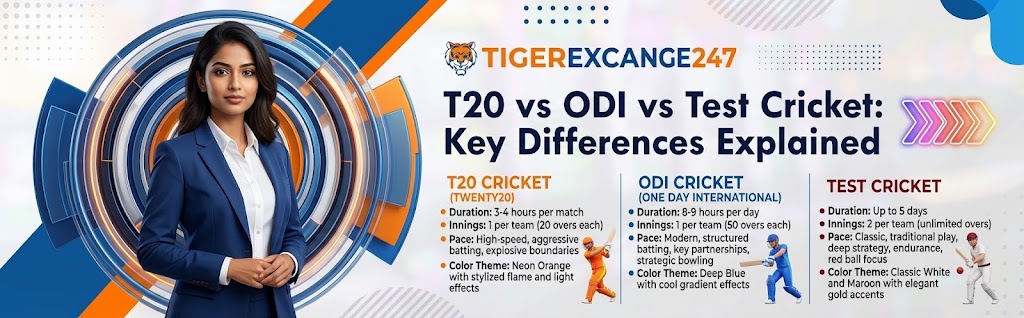
There are 3 main international forms of cricket and each one is a completely distinct experience for players and viewers. T20 vs ODI vs Test cricket : Compare overs, innings, match duration, scoring, bowling plans and the manner in which teams manage risk.
T20 is the shortest and fastest format of the game with 20 overs to each side. ODI sport allows more time to build an innings, whereas Test cricket can last up to five days and gives each team generally two innings.
Newbies need to understand that these formats are the same player can use totally different tactics depending on the match. A Test player who starts a T20 innings with a big hit may focus on patience and defense.
This guide outlines the key T20 versus ODI vs Test differences in simple English. You’ll find out how each format works, why scoring rates change, how bowling and fielding methods alter and what makes each version of the game distinct.
T20 vs ODI vs Test – A Quick Comparison
| Feature | T20 | ODI | Test |
| Overs | 20 per innings | 50 per innings | No fixed limit |
| Innings | 1 per team | 1 per team | Normally 2 per team |
| Ball | Usually white | Usually white | Traditionally red |
| Typical duration | Around 3 hours | Around 7–8 hours | Up to 5 days |
| Scoring approach | Aggressive | Balanced | Patient |
| Main skill | Speed and power | Adaptability | Technique and endurance |
| Playing style | Fast-paced | Strategic | Long-form |
The exact length of a match can vary because to rain, interruptions, over rates and playing conditions.
What Is T20 Cricket?
T20 is the shortest of the three main formats of cricket. Each team usually has 20 overs in a full innings.There is not much time to get back on track after a sluggish start.
Because the innings are short batsmen are usually looking to score early. Hitting boundaries and quick singles and rotating the strike becomes vital. Bowlers need to have accurate variety to control the scoring rate.
A typical T20 innings will have a number of tactical phases:
- Opening powerplay
- Middle overs
- Last overs or death
- Specialized bowling possibilities
- Quick modifications in field location
One of the most obvious T20 vs ODI vs Test disparities is the value of each delivery. In a 20 over game, a few overs of defensive batting might make it tough to get to a competitive score.
An example of T20
Suppose a side is scoring slowly in the first six overs. It could have to attack strongly later, which increases danger. Often the same slow start, in a lengthier format, can be more comfortably recovered.
That is why T20 requires quick decision making by both batsmen and bowlers.
Related Internet Search Term
Tigerexch 365 is something readers may sometimes see when searching for cricket-related services online. These 3rd party search phrases are separate from official cricket formats, regulations and regulatory bodies and need to be treated separately.
What Is ODI Cricket?
In ODI cricket each team is allowed a maximum of 50 overs. It’s lengthier than T20 but still has a predetermined limit so teams have to combine the speed of scoring with the preservation of wickets.
An ODI innings generally develops as it goes along. Batters can start with a measured aggression, develop partnerships in the middle overs and then up the run rate as the innings draws to a close.
The common fundamental steps are:
- 1st Powerplay
- Developing partnerships
- Middle over rotation
- Go faster
- Attacking play in the last over
This makes it easy to appreciate the difference between T20 ODI and Test cricket as ODI cricket allows players more time to analyze circumstances and manage risk.
An ODI hitter does not have to attack every delivery. Instead, the idea is frequently to develop a strong platform and end with maximum scoring opportunities.
What Is Test Cricket?
Test cricket is the longest version of the sport of cricket and is considered the highest standard. A match might conclude before all innings are played. Normally, each team plays two innings.
Unlike limited-overs cricket, test innings are not restricted to a set number of overs. A side bats until it is dismissed or the innings is ended by the relevant match regulations.
Test cricket is worthier:
- Defensive skills
- Patience.
- Target
- BOWLING STAMINA
- Placement practice
- Pitch evaluation
- Long term planning
A batter can sit at the crease for hours, bowlers can attack the same weakness over and over in long intervals.
This is one of the greatest contrasts between T20 vs ODI vs Test. Time is a tactical resource in Test cricket.
T20 vs ODI vs Test Differences
When you look at the framework of each you will notice the variations between T20, ODI and Test are more obvious.
Number of Overs
The basics of the over limits are simple:
- T20: Twenty overs
- ODI: 50 ov
- Test: No restriction on overs of innings
“In T20 there is more pressure to score runs quickly as there are limited overs. The time structure of Test cricket is completely different . ODI cricket allows more chances to fall back .
Number of Innings
T20 and ODI teams usually bat once.
Test teams generally get two innings. This allows for tactical possibilities such as declarations and follow-on situations under the relevant playing conditions.
Duration of Match
The T20 ODI test match duration is very different.
A T20 is usually done in a few hours. An ODI normally occupies most of a day whereas a Test might run for more than five planned days.
These are typical playing windows, not guarantyd timeframes.
Batting Strategy
T20 batting is usually attacking. ODI batting needs timing and Test batting needs durability and technique.
Bowling Strategies
T20 bowlers have limited overs and must make the most of each opportunity. ODI bowlers can go through phases, and Test bowlers have a lot more time to create pressure.
Fielding Strategy
Captaincy decisions are heavily influenced by fielding limits in limited-overs games. In test cricket, captains have a wider tactical canvas and more scope for close catchers.
T20 vs ODI vs Test Rules
The core regulations of cricket are the same but playing conditions mean T20 vs ODI vs Test rules are different in a number of key areas.
Powerplays
There are fielding restrictions in several stages of limited-overs cricket. Specific regulations may differ by competition.
Bowling Restrictions
There is a cap on the amount of overs a single bowler may bowl in T20 and ODI cricket. There is no set individual-over restriction in test cricket.
Follow on
The follow-on is linked with Test cricket. In certain circumstances, a team with a sufficiently substantial first innings disadvantage may be obliged to bat a second time.
Statements
A Test captain can declare an innings ended, usually when the team feels it can generate a better chance to take wickets and push for a result.
Weather
Weather can alter any format. The number of overs may be reduced in limited overs cricket. In Test cricket, missed time might mean fewer available sessions.
General explanations should always be subordinated to the unique conditions of play for the competition.
T20 ODI Test Match Time Explained
By looking at the length of T20 and ODI Test matches we may understand why the strategies are so different.
| Format | Typical Duration | Innings | Overs |
| T20 | About 3 hours | 1 per team | 20 |
| ODI | About 7–8 hours | 1 per team | 50 |
| Test | Up to 5 days | Normally 2 per team | No fixed limit |
The duration of the T20 ODI test match can be varied according to interruptions, weather, over rates, and length of each inning.
A test is not 5 full days by default. A game can terminate earlier if a team wins by an inning, completes a chase, or another result is achieved.
T20 v ODI v Test Scoring
Always compare T20 vs ODI vs Test scores in the context of the format.
T20 cricket is often a high run rate game, as a batting side has only 20 overs. Players might take more risk as they cannot wait too long, or there will be too many runners to chase in the latter stages.
ODI scoring is not very strict. One segment may be played at a modest tempo and then speed up later.
The test can take significantly longer to score. A batter could sit back or stay away for a while and then go for broke.
Hence, it’s deceptive to merely compare a batsman’s scoring rate across all three formats. The availability of delivery and the match circumstances matter.
Batting Strategies in Different Formats
T20 Batting Approach
T20 hitters have to think on their feet. They may go for the edges, take calculated risks and look to keep the pressure on early on.
ODI Batting Approach
The ODI cricket format allows more time to create partnerships. Batters can judge conditions, rotate the strike, and look to accelerate in later overs.
Test Batting Tactics
Test cricket is a game that rewards patience and defensive technique. Players have to decide which balls to pursue, defend or ignore, and keep their focus for lengthy durations.
So the difference between T20 ODI and Test cricket is not just the length of the match but also the decision making.
Bowling Style for Various Formats
T20 bowlers often work in brief spells, specific programs. Variations of pace, yorkers and field protection can be particularly significant.
In ODIs bowlers get more chances to formulate a plan across multiple spells. They can change the bowler at the beginning, middle overs and closing stages.
Test bowlers have a lot more endurance. They might go after a batter’s vulnerability until a chance presents itself.
This is another key aspect of T20 versus ODI vs Test, as bowling varies as radically as batting.
Fielding and Captaincy
The format also influences captaincy.
“In T20, the captain doesn’t get time to think, one over can change the game.
In ODI cricket, captains can make more long term decisions in terms of wickets, partnerships, and bowling rotations.
Test captains think several sessions ahead. They can lay down aggressive fields, employ defensive tactics, rotate bowlers and manage declarations.
The T20 vs. ODI vs. Test distinctions become obvious when the same players play in all three forms. It is the tactical variances.
Which Format Is More Difficult?
Different formats test different talents, therefore there’s no general answer.
T20.
T20 needs:
- Snap choices
- Power – bashing
- Quick response
- Flexibility
ODI
ODI cricket wants:
- Balance .
- Pacing
- Building Partnerships (2)
- Tactical Consciousness
Test
Test cricket demands:
- Stability
- Technical
- Durability
- Focus
It is better to understand the difference between T20 ODI and Test cricket in terms of the talents required of the players than to say that one is more difficult.
More Cricket-Related Online Searches
Another term that you may come across online is tigerexchange apk. This is a third party search phrase and is not an official web app.
If you are looking for internet services, check the source before you install software you don’t know and don’t share passwords or verification codes.
T20 vs ODI vs Test: Equipment and Playing Conditions
The white ball is traditionally linked with T20 and ODI cricket whereas the conventional test match is played with a red ball in regular daytime conditions.
Preparation also depends on playing conditions. T20 players frequently have to play high intensity for a shorter period of time. Test players have to concentrate for days on end, ODI players get a full day.
Such variances influence the training, recovery, and pre-match preparation of players.
More Online Cricket Search Terms
Some individuals may want to search india betting id when searching for internet services relating to cricket. These services are apart from the formal rules and administration of international cricket.
Readers should consult the official cricket organizations for details about tournaments, rules and match statistics.
T20 versus ODI vs Test: The Battle Royale
| Category | T20 | ODI | Test |
| Overs | 20 | 50 | No fixed limit |
| Innings | 1 | 1 | Normally 2 |
| Duration | Around 3 hours | Most of a day | Up to 5 days |
| Ball | White | White | Traditionally red |
| Batting | Aggressive | Balanced | Patient |
| Bowling | Short spells | Tactical phases | Long spells |
| Strategy | Fast decisions | Pacing | Long-term planning |
| Main challenge | Speed | Balance | Endurance |
The T20 ODI test match duration differential is one of the simplest ways to recall how the 3 formats work for novices.
Beginner Tips
If you are new to cricket start with the basic framework.
Firstly, know what an over implies and remember that there are usually six legal deliveries in an over. Then discover how wickets, runs and run rate effect a limited overs match
T20 is a useful introduction to speedier decision making after you get to grips with the T20 format of cricket.
You can then move on to the longer version of ODI cricket and see how teams build an innings: Then Test cricket can bring in things like declarations, follow ons and multi-day strategy.
Common Errors to Avoid
Common blunders that novices make:
- Assuming that all formats have the same amount of overs.
- T20 vs Test scoring rates direct comparison.
- Forgetting that Test teams generally play two innings.
- Expecting Test cricket to be over in one day.
- Assuming ODI batsmen need to hit every ball.
- Bypassing the bowling and fielding limits.
- Assuming all conditions of tournament play are the same.
These basics make T20 vs ODI vs Test much easier to understand.
Another Online Cricket Search Term
Readers may also find tiger365.pro login when surfing the web. This is not part of the formal cricket format information so please do your own research on any third-party service before engaging with it.
Official cricket websites will remain the major source of information on rules, fixtures, results and tournament details.
New Tiger Exchange ID Lookups
Another phrase that sometimes comes up in web searches linked to cricket is “tiger exchange new ID.” This is not part of official regulations or statistics for T20, ODI or Test.
Always verify with recognized cricket boards, tournament websites and respected sports sources for accurate cricket facts.
Frequently Asked Question
What is the major distinction between T20 ODI and Test cricket?
The main changes are the amount of overs in the innings and the match length. T20 is usually 20 overs a side ODI is 50 overs a side and Test cricket is usually two innings a side with no overs set per innings.
How many overs in a T20 game?
Typically a T20 innings consists of 20 overs for each team.However if weather or other disruptions occur the number of overs may be lowered according to the relevant competition regulations.
How many overs are played in ODI cricket?
Each side usually gets 50 overs in an ODI. If the match is interrupted by rain or otherwise the number of overs may be lowered in accordance with the relevant playing conditions.
How long is Test cricket?
Test matches are played over at most five days but might end early if a result is achieved. It has no defined number of overs every innings.
What format is best for beginners?
T20 is frequently the simplest place to start because the games are shorter and the action is fast. ODI cricket is a nice medium ground while Test cricket brings in deeper tactical and technical elements.
Conclusion
The T20 vs ODI vs Test comparison explains why cricket can feel like three separate versions of the same game. T20 means playing attacking cricket at a fast pace and making quick decisions. ODI cricket is a better balance better pace and the opportunity to establish partnerships. Test cricket is about technique patience and long term thinking.
The main distinctions between T20 ODI and Test are overs innings duration scoring bowling and strategy.The T20 cricket format is all about instant action. The ODI cricket format is a balanced limited overs match. The Test cricket format is all about a long tactical battle.
For starters mastering the basic rules first makes any format easier to follow. Cricket is a lot more fun to watch and appreciate once you understand the diverse ways each game uses time and resources.